

In-Cell or Soft OLED: when is the upgrade worth it?
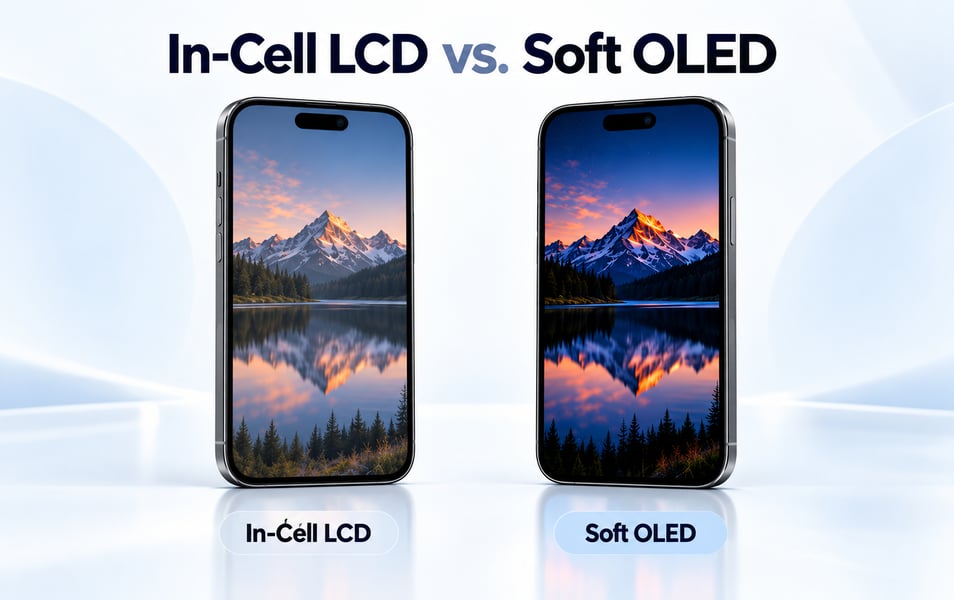
When replacing an iPhone display, price is often one of the first considerations. An In-Cell LCD offers an attractive way to keep the repair affordable. But when a Compatible Soft OLED alternative is available, spending a little more can make a significant difference to the quality of the repair.
For example, within our current range, the price difference between In-Cell LCD and Compatible Soft OLED is:
- iPhone 12: approximately €14
- iPhone 13: approximately €14
- iPhone 13 Pro: approximately €13
- iPhone 14: approximately €14
- iPhone 14 Pro: approximately €31
- iPhone 15: approximately €30
- iPhone 16: approximately €25
So, what do you actually get for that additional investment?
LCD versus OLED
The first major difference is the display technology itself.
An In-Cell replacement uses LCD technology. It is a good and cost-effective replacement option, but it works differently from the OLED technology originally used in many modern iPhones.
A Compatible Soft OLED uses OLED technology and therefore comes much closer to the characteristics of the original display.
That difference is noticeable every day the phone is used.
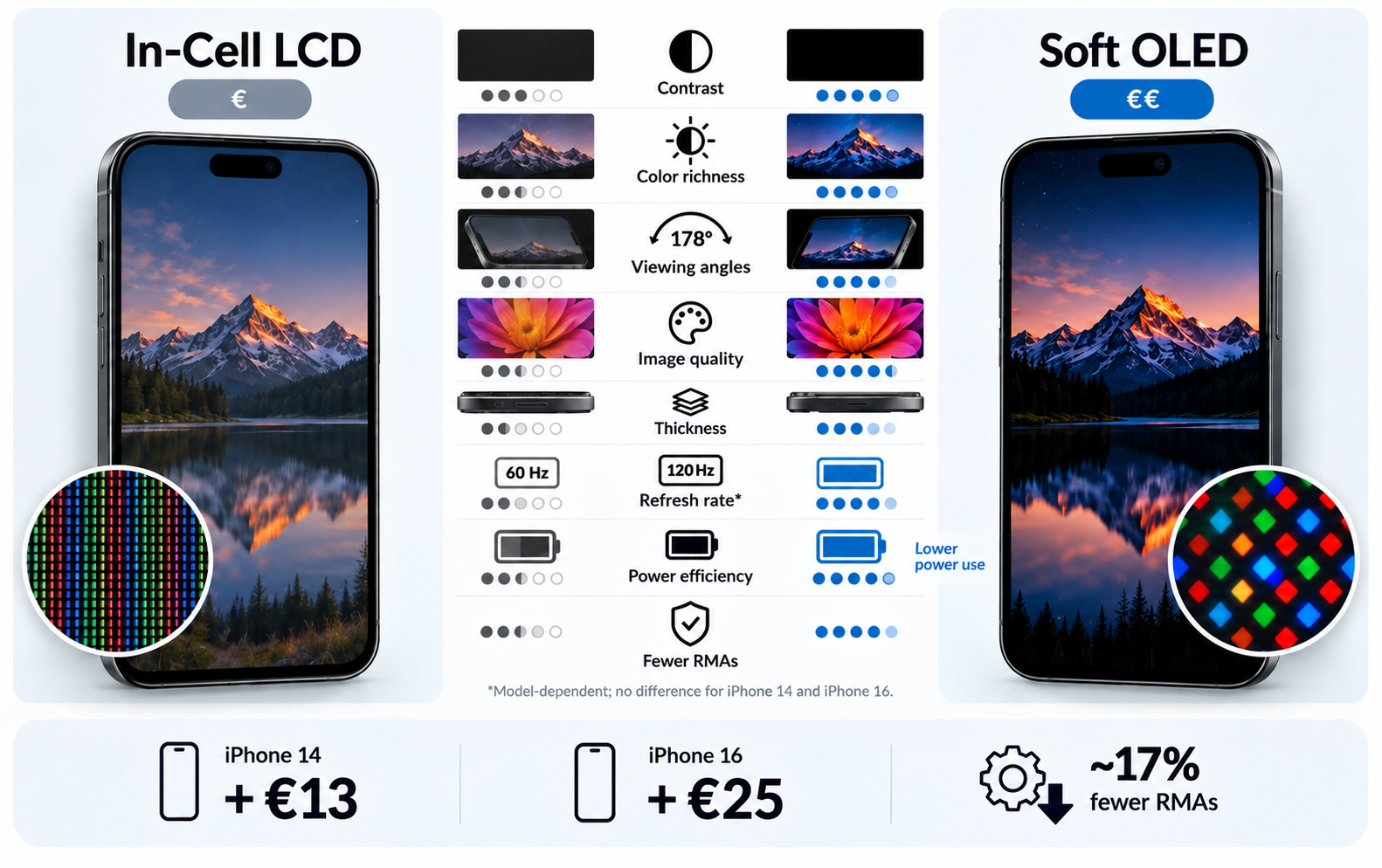
1. Deeper blacks and higher contrast
An LCD needs a backlight behind the display. Even when an area of the screen should be completely black, the backlight remains active.
With OLED, every pixel produces its own light. When a pixel needs to display black, it can simply switch off.
The result is:
deeper blacks, stronger contrast and a more premium-looking image.
This is especially noticeable in dark mode, photos, videos and apps with dark backgrounds.
2. Lower power consumption
Power efficiency is another important advantage of Soft OLED.
Because an LCD requires a backlight to illuminate the entire display, power is used even when large parts of the image are dark.
OLED works differently. Individual pixels generate their own light and black pixels can be switched off completely.
Especially when using:
- dark mode
- dark backgrounds
- apps with large black areas
- video content with darker scenes
a Soft OLED display can use less power than an LCD alternative.
Actual battery consumption always depends on brightness, displayed content and usage, but the OLED technology itself has a clear efficiency advantage when displaying darker content.
For a customer who uses the phone every day, this is another reason why Soft OLED can provide a more original-like experience.
3. A smoother experience on several Pro models
Refresh rate is another difference that should not be overlooked.
A higher refresh rate means that the display can update the image more frequently per second. This makes scrolling, animations and transitions appear smoother.
The difference does not apply to every model. For example, our iPhone 14 and iPhone 16 In-Cell and Soft OLED displays both operate at 60 Hz.
But on several Pro models, the difference is substantial.
Examples from our range include:
| Model | In-Cell LCD | Compatible Soft OLED |
|---|---|---|
| iPhone 13 Pro | 90 Hz | 120 Hz |
| iPhone 13 Pro Max | 90 Hz | 120 Hz |
| iPhone 14 Pro | 90 Hz | 120 Hz |
| iPhone 14 Pro Max | 90 Hz | 120 Hz |
| iPhone 15 Pro | 90 Hz | 120 Hz |
| iPhone 15 Pro Max | 90 Hz | 120 Hz |
| iPhone 16 Pro | 90 Hz | 120 Hz |
| iPhone 16 Pro Max | 90 Hz | 120 Hz |
| iPhone 17 | 90 Hz | 120 Hz |
This can be particularly relevant for customers with a Pro model who are accustomed to a very smooth display experience.
With these models, upgrading to Soft OLED does not only improve contrast and black levels — it can also provide a higher refresh rate and noticeably smoother operation.
For the iPhone 17 Pro and 17 Pro Max in our current range, both display options already support 120 Hz.
4. Closer to the original display experience
Customers who own an iPhone with an original OLED display are used to a certain level of image quality.
Replacing that screen with an LCD changes some of those characteristics.
Soft OLED retains more of what the customer is accustomed to:
- deeper blacks
- higher contrast
- better viewing angles
- OLED image characteristics
- potentially lower power consumption
- higher refresh rates on several models
- a construction closer to the original OLED display
For a relatively small additional investment, the repaired phone can therefore feel considerably closer to the original.
5. Around 17% fewer RMAs
Image quality is not the only consideration.
Our own RMA data shows that Compatible Soft OLED has approximately 17% fewer RMAs than In-Cell.
For a professional repair company, that is important.
An RMA can mean:
- additional repair time
- another customer visit
- extra administration
- additional logistics
- downtime for the end user
- a less positive customer experience
A lower RMA rate therefore has value beyond the cost of the display itself.
The additional investment in Soft OLED buys not only better display technology, but according to our own sales data, also a lower likelihood of an RMA.
Put the additional cost into perspective
For an iPhone 14, upgrading to Compatible Soft OLED costs approximately €13 more.
For an iPhone 16, the difference is approximately €25.
In return, the customer gets OLED technology with deeper blacks, stronger contrast, potentially better power efficiency and a display experience that is closer to the original.
On several Pro models, Soft OLED also offers 120 Hz instead of 90 Hz, providing an additional improvement in smoothness.
And across our own sales, Soft OLED shows around 17% fewer RMAs.
So instead of asking:
“Do you want to spend €13 or €25 more on the display?”
the more relevant question is:
“Do you want the lowest-cost repair, or do you want a display that comes closer to the original in image quality, technology and overall user experience?”
Two qualities for two different needs
In-Cell LCD
A cost-effective solution for customers for whom keeping the repair price as low as possible is the main priority.
Compatible Soft OLED
A higher-quality compatible solution for customers who value image quality, OLED technology, power efficiency, smoother refresh rates where supported, and an experience closer to the original display.
For many customers, the additional €13 or €25 is relatively small compared with the value of the device and the amount of time they will continue using it.
A relatively small difference in repair cost can make a noticeable difference every single day the customer uses the phone.

Related articles
-
Refresh rate: an important display specification that's often overlooked
Learn why refresh rate is crucial for iPhone displays, impacting user experience and customer satisfaction. Explore how to choose the best display for repairs.
Read more -
New: Original Pulled iPhone batteries available in multiple Battery Health grades
Discover the benefits of Original Pulled iPhone batteries, offering genuine quality and multiple Battery Health options to suit every repair and budget.
Read more -
Why does an iPhone display show "Used" after Apple calibration?
Learn why iPhone displays show "Used" after calibration, the differences between display statuses, and how to choose the right replacement for your repairs.
Read more