

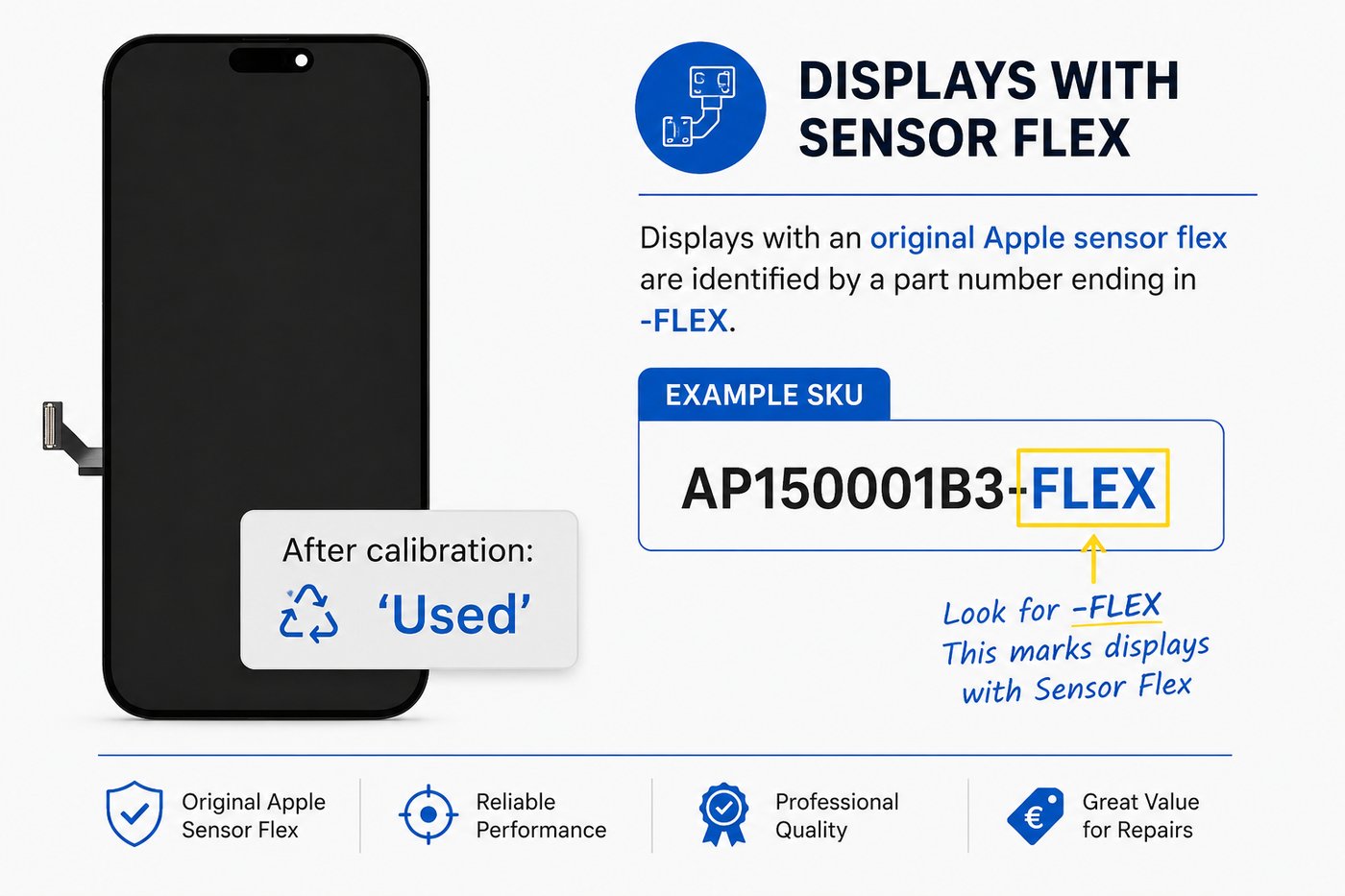
Why does an iPhone display show "Used" after Apple calibration?
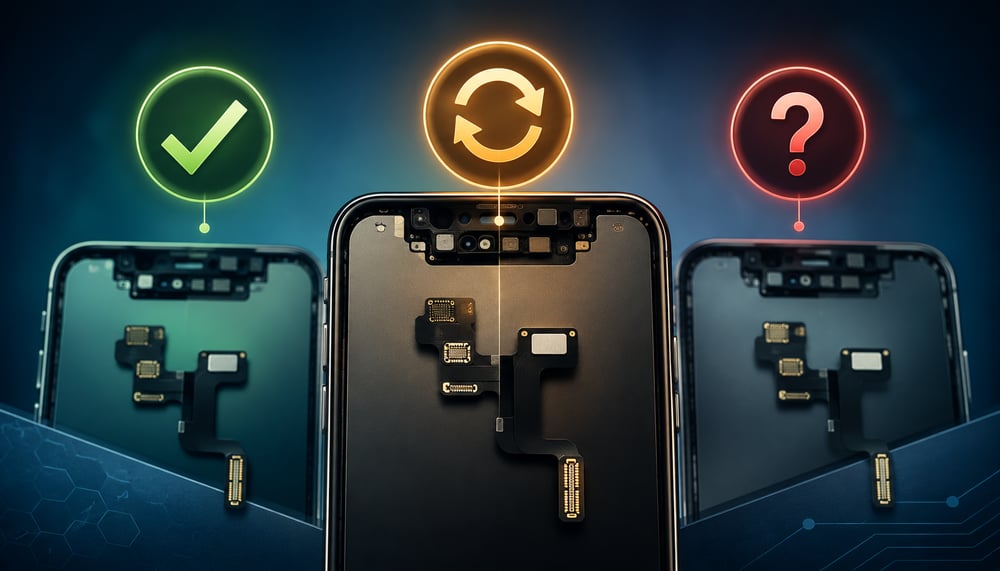
Apple's System Configuration has changed the way repaired iPhones identify replacement displays. One of the most common questions repair professionals ask today is:
"Why does this display show 'Used' after calibration instead of 'Genuine'?"
The answer is simple: Apple is identifying the history of the display assembly—not the quality of the repair.
Understanding what the different calibration results mean allows you to explain repairs more confidently and help your customers make informed choices.
Apple's three display statuses
After running Apple System Configuration, an iPhone display can receive one of three statuses.
Genuine
A Genuine status indicates that a new Apple Service Part (Service Pack) has been installed and successfully calibrated.
This is the only display type that Apple identifies as new.
Typical display type:
Used
A Used status indicates that Apple recognizes the display as an original Apple display that has previously been registered.
This is normal for:
These displays remain genuine Apple displays, but because they have already been activated in Apple's systems, they are identified as Used after calibration.
This does not indicate poor quality or an incorrect repair.
Unknown
An Unknown status is shown when installing a Compatible display, or an Pulled or Refurbished without the original Sensor Flex.
These displays are not registered within Apple's ecosystem and therefore cannot receive either the Genuine or Used status.
Modern compatible displays can still deliver excellent image quality and performance, but Apple identifies them as third-party components.
Why do Refurbished and Pulled displays show "Used"?
A Pulled and Refurbished display starts life as an original Apple display.
During refurbishment:
- The broken glass is replaced.
- The OLED panel is restored if necessary.
Apple has already registered this display assembly in its system, so after System Configuration it is recognised as a previously used genuine display.
For this reason, the calibration result becomes:
Used
This behaviour is completely normal and expected.
What about the Front Sensor Flex?
Many repair technicians assume the calibration result depends on the front sensor flex.
That is only partly true.
Apple now treats the display assembly and its original matching sensor flex as one genuine component set.
For Refurbished and Pulled displays, this matching sensor flex is already part of the original display assembly.
For Compatible displays, no original Apple sensor flex is included. During installation, the technician must transfer the customer's original front sensor flex to the replacement display following the correct repair procedure.
Choosing the right display
Every display type has its own advantages.
| Display type | Apple status | Best for |
|---|---|---|
| Apple Genuine | 'Genuine' | Customers who want a brand-new Apple part |
| Pulled (with sensor flex) | 'Used' | Original Apple display removed from another device |
| Pulled | 'Unknown' | |
| Refurbished (with sensor flex) | 'Used' | Genuine Apple quality at a lower price |
| Refurbished | 'Unknown' | |
| Compatible (with sensor flex) | 'Used' | Cost-effective repairs with excellent value |
| Compatible | 'Unknown' |
Understanding the "Used" status
Some customers mistakenly believe that a Used status means they received a second-hand or inferior display.
This is not correct.
The status simply means Apple recognizes the display as a genuine Apple component that has been registered before.
For many repair businesses, refurbished displays offer an excellent balance between:
- Original Apple quality
- Lower repair costs
- Reliable performance
- Successful Apple calibration
Conclusion
Apple's calibration system is designed to identify the origin of a display, not to judge the quality of the repair.
- Genuine = New Apple Service Part
- Used = Original Apple display that has previously been registered
- Unknown = Compatible display, or an Pulled or Refurbished without the original Sensor Flex.
Understanding these differences helps repair professionals explain repairs with confidence and recommend the display that best suits each customer's expectations and budget.
Important installation instructions for Compatible displays
The following instructions only apply to Compatible displays of Mobileparts.shop.
Refurbished and Pulled displays already contain their original Apple electronics and do not require this procedure.
Installation procedure
Compatible displays are supplied without the front sensor flex cable. During the repair, the original front sensor flex from the customer's device must be transferred.
To ensure successful calibration, follow these steps:
- Install the compatible display without transferring the original front sensor flex.
- Do not transfer the True Tone data before installation.
- Connect the display and run Apple Diagnostics / System Configuration.
- After calibration has completed successfully, transfer the original front sensor flex from the customer's display to the compatible display.
- Reassemble the device and perform a complete functional test of the display, sensors, earpiece and Face ID.
Important notes
- These instructions only apply to Compatible Soft and Hard displays.
- Compatible displays are supplied without a front sensor flex cable.
- Always reuse the customer's original front sensor flex.
- Refurbished and Pulled displays already contain the original Apple electronics and do not require this procedure.
- Always follow Apple's recommended calibration process and use professional repair equipment to achieve the best repair result.

Related articles
-

JK vs Moshi In-Cell Displays
Compare JK and Moshi iPhone In-Cell LCD screens to discover which is best for your repair needs based on resolution, color accuracy, touch sensitivity, and power consumption.
Read more -
Why professional testing for compatible iPhone batteries matters — and why you should demand it!
Learn how Mobileparts.shop ensures top-quality iPhone batteries through rigorous testing done by suppliers, safeguarding your repairs and customer safety.
Read more -

New: Pulled iPhone 16/17 front cameras – directly calibratable without an additional flex
Discover the new iPhone 16/17 front cameras that are pre-tested for calibration, making repairs faster and simpler for technicians.
Read more